
Best practice makes you interchangeable to your customers.
An advantage does not happen by chance. We design it with you: a position your competitors cannot copy, and a business model that turns your brand into profit. You do not need a bigger budget than the others for that. You need to think further. One sprint day after another, one to one. It gets uncomfortable. That is the only way to challenge your market.
Book a discovery callThree phases, bookable separately: problem, strategy, execution.
Clarity means understanding: where does the problem actually lie, and what has to be decided? Strategy means designing: how does the advantage come about that lets you challenge your market? Focus means staying with it: how do you keep putting it into practice?
A sprint day runs six to eight hours and starts at €2,500. Book one, or as many as you need. A complete architecture takes four to five.
Three starting points, one approach
You are repositioning.
Fresh funding has arrived. Now your business model has to carry what is meant to come of it, and in most cases that means positioning, pricing and architecture are built anew.
You are strengthening what is there.
The architecture exists, but it has gaps. The price is off, the position is blurred, or you are speaking to the wrong customers. We find the weak points and close them.
You are defending your ground.
You have become visible and the competition is reacting: copying you, undercutting you or pushing you out, and every quarter it gets tighter. You need a strategy that outmanoeuvres them. Not another feature.
In all three cases the same thing emerges: an architecture that creates value.
For your customers, for you, for your investors. In all three cases your business model may change in the end. Sometimes your product too, sometimes even who your customers are. That sounds like going backwards. It is the first decision that gives you an advantage.
The three phases: clarity, strategy, focus
Clarity sprint: finding the problem.
The real problem is rarely the one you take it for. We look at your product, your differentiation and the value your customers see in it. By the end you know what it actually comes down to.
Revenue has stalled, pitches go unanswered, customers drop off. Something is wrong and you cannot name it.
named, with the steps that follow now
and why it does not land with your customers
and whether you are interchangeable to your customers
together with what you have to cut for it
Strategy sprint: positioning and business model.
How do you have to be set up to hold an advantage in your market? Positioning, pricing, competition, your customers and the value they see in you: every one of those decisions brings the advantage closer or costs it. Out of that comes your strategy, either as something new or as an existing business that stands considerably stronger afterwards. In the end your business and brand architecture puts product, customers and business model together so that they reinforce one another.
You sound like your competitors. Or they are catching up since you became visible. Or you cannot say in one sentence why customers buy from you and not elsewhere. Each of those costs you margin, and in the end growth.
in which product, customers and business model reinforce one another
in a language that convinces investors too
tested for whether your competitors can copy it
that your customers see, in words rather than features
and the criteria they buy on
that says what makes you valuable and different
Focus sprint: putting the strategy to work.
The most common question after a strategy sprint is: what now? Focus is the answer. Eine Strategie greift erst, wenn sie umgesetzt wird: an jedem Touchpoint, in Marketing und Sales, so dass eure Kunden sie erleben. Und sie hält nur, wenn die nächsten hundert kleinen Entscheidungen in dieselbe Richtung gehen. Lockt ein Trend, drängt ein Investor oder winkt ein schneller Umsatz, ist die bequeme Entscheidung selten die richtige. Ihr trefft trotzdem die richtige. Ihr könnt sagen, warum, und was daraus folgt.
The strategy is set, but it has not reached your customers yet. And next quarter it should still hold.
from the website through the pitch to onboarding new people
sales funnel, landing pages, pitch deck, redesigned or sharpened
whether you are five people or fifty
because every touchpoint tells the same story
because you answer every move your competitors make faster than they answer yours
That is why focus is not a one-off. A lead only holds as long as you defend it, quarter after quarter. Those who do become the first choice in their category and stay there.
From €2,500 per sprint day
How many days you need and what a day costs for your team size, we settle in the discovery call before you book anything. Price plus VAT.
What we work on together: Where your competitors stand and which gap they leave open. Who your customers become through you and what they really decide on. Which price reflects your value and which business model turns that into a profitable business. Depending on your phase, the emphasis sits elsewhere.
Here, profit is not a result you wait for, it is material we work with. We calculate what your decisions mean: which price produces which margin, which model carries you, where sameness is costing you money right now.
Book a discovery call
Branding for startups: the brand is the result
And where is the brand in all this? You already have one. Every company does, whether it works on it or not. Your brand is your reputation, and your customers decide what it is.
You can still influence it. That is branding: making sure as many people as possible think the same thing about you, and that it is what your strategy intends. It is decided at every touchpoint, in every conversation, with every purchase. And that is what decides whether you become valuable to your customers or stay interchangeable.
A strong brand is therefore not a marketing question, it is the most effective financial strategy you have. It lowers the cost of acquisition, hiring and discounts, and it makes prices stick. That is why this page says so little about brand and so much about decisions. The brand is the result.
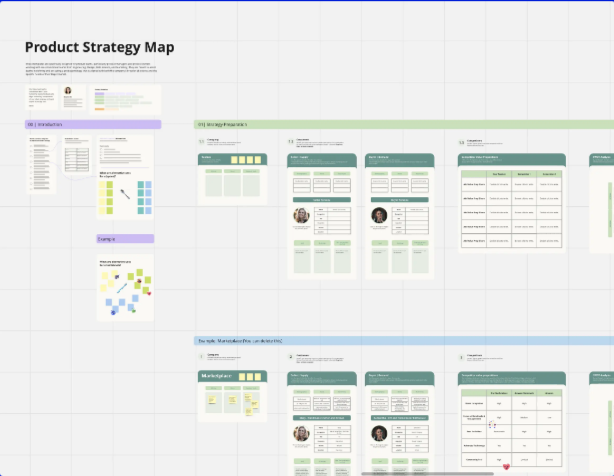
The result: no PDF for the drawer.
Everything we work out ends up filled in on your Miro board: your architecture, your position, your pricing, your ideal customer. Not a report someone reads once. A board that sales, marketing and every new person on the team keeps working with.
Frequently asked questions
Programmes are built to help many at once, so they work with what has proven itself generally. A sprint looks for the opposite: what works only for you and what your competitors cannot copy. The two do not exclude each other. Many of our clients are in a programme at the same time.
No. Every sprint day delivers a result of its own. You decide afterwards whether another one follows.
Yes, if you know where your problem lies. If not, that is what clarity is for.
From €2,500 per sprint day. How many days you need and what a day costs for your team size, we settle in the discovery call before you book anything.
A sprint day runs six to eight hours. You book as many as you need. A complete business and brand architecture takes four to five, spread over several weeks so you can work in between.
Everyone who decides. A strategy built without the decision-makers never gets implemented. And bring the people who talk to your customers most. What someone knows counts for more here than their title.
Possibly. Sometimes your product too, sometimes even who your customers are. That sounds like going backwards. It is the first decision that gives you an advantage.
Bei euch ist noch eine Frage offen?
Wenn hier etwas fehlt, schreibt eine Mail. Dafür müsst ihr keinen Termin buchen.
Frage stellen